
VareYa
Ecommerce packaging

Smarter Ecommerce Packaging: From Product to the Right Shipping Profile

Effective ecommerce packaging does more than protect a product.
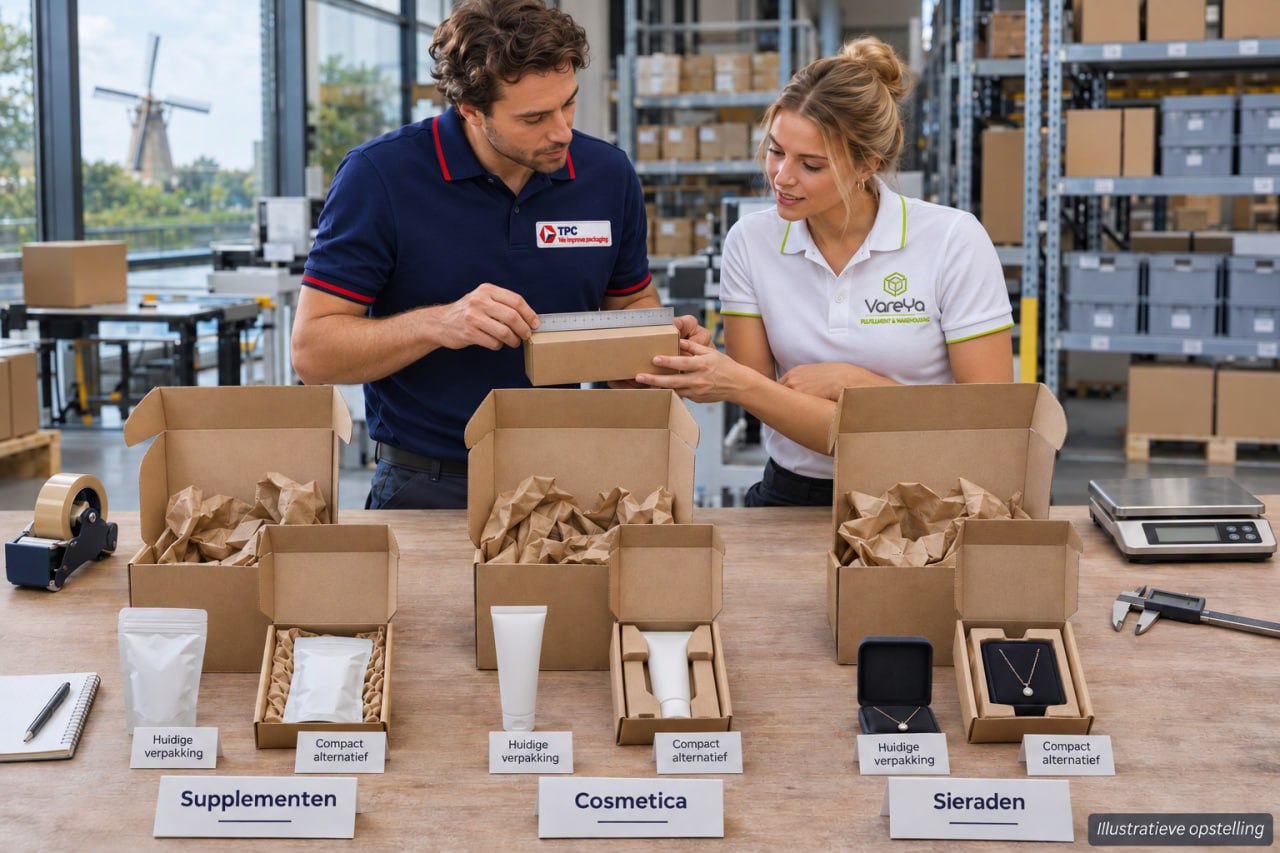
TPC and VareYa representatives with packaging samples at a packing station.

Packaging and shipping

Its dimensions, weight and materials can directly affect fulfilment efficiency, warehouse handling and the shipping options available for an order.

This is particularly relevant for compact and lightweight products.

Instead of treating packaging, fulfilment and shipping as separate decisions, it can be more effective to consider the entire process as one connected chain.

Trias Packaging Company (TPC) and VareYa bring together packaging expertise and practical ecommerce fulfilment experience to explore this approach.

Why is packaging optimisation important for ecommerce?

A compact product does not automatically result in a compact shipment.

Supplements, cosmetics, jewellery and accessories may be small and lightweight, but oversized boxes or unnecessary void fill can substantially increase the final dimensions of a shipment.

When optimising ecommerce packaging, it is therefore important to consider: product dimensions and weight; required product protection; dimensions of the shipping packaging; amount of void-fill material required; efficiency during picking and packing; opportunities for a more compact shipping profile; potential suitability for letterbox or mailbox-compatible delivery.

The objective is not simply to use the smallest possible box.

The objective is to find packaging that fits the product, the fulfilment process and the shipping method.

When is a product suitable for letterbox packaging?

A small product is not automatically suitable for letterbox delivery.

The complete shipping profile needs to be considered: Product + Protection + Packaging + Dimensions + Weight + Carrier Requirements TPC offers different types of shipping packaging, including letterbox boxes, postal boxes and customised packaging solutions.

By considering the final shipping method during the packaging selection process, businesses can determine whether a product can be packed more efficiently without compromising the protection required during storage, handling and transportation.

What does packaging have to do with fulfilment?

More than is often assumed.

Within an ecommerce fulfilment operation, packaging can affect: storage space for packaging materials; packing station configuration; the number of packaging formats required; use of void-fill materials; handling during picking and packing; final shipment dimensions; available carrier and shipping options.

A packaging solution therefore needs to work in practice, not just on paper.

It must be possible to use the packaging efficiently and consistently within the warehouse operation.

This is where the expertise of TPC and VareYa comes together.

Combining packaging expertise with ecommerce fulfilment

TPC supports companies with packaging materials, customised solutions, packing workstations, packaging machinery and optimisation of packaging processes.

VareYa contributes the operational ecommerce fulfilment perspective.

From the Netherlands, VareYa supports international ecommerce brands with warehousing, order processing, pick & pack, returns and shipping, with a particular focus on compact and lightweight products.

Together, packaging and fulfilment can be assessed as one process: Product → Packaging → Fulfilment → Shipping

How does ecommerce packaging optimisation work in practice?

A practical packaging analysis can be approached in five steps.

1. Define the product profile

Start by documenting the product's dimensions, weight, fragility and protection requirements.

2. Assess the existing packaging

The existing shipping format, packaging material and any void fill can then be evaluated.

The central question is: Does the existing packaging genuinely fit the product and its order profile?

3. Explore a suitable alternative

The next step is to determine whether a different standard box, postal box, letterbox box or customised packaging solution offers a better fit.

4. Test the fulfilment process

Any alternative packaging must also work effectively during storage, picking and packing.

A smaller package that requires significantly more handling or provides insufficient protection is not necessarily a better solution.

5. Reassess the shipping profile

Only after the complete packaged order has been assessed should the available shipping options be reconsidered.

This changes the traditional question: Which box should we use for this product? into: Which combination of product, packaging, fulfilment and shipping best fits this order profile?

Three Practical Ecommerce Product Profiles

TPC and VareYa can make this approach tangible by analysing different ecommerce product profiles.

Nahrungsergänzungsmittel

Supplement products can vary considerably in shape and packaging, from containers and pouches to sachets and other compact formats.

For each product, the amount of protective and shipping packaging actually required can be assessed.

Kosmetik

For cosmetics, dimensions are only part of the equation.

Packaging materials, containers, closures, fragility and the protection required during warehouse handling and transportation also need to be considered.

Jewellery

Jewellery is often compact and lightweight, but product protection and presentation remain important.

This makes the combination of the primary product packaging and the external shipping packaging particularly relevant when exploring optimisation opportunities.

For each product profile, the existing and potential alternative packaging can be compared:

For each product profile, the existing and potential alternative packaging can be compared:
ElementAssessment
Product dimensionsLength × width × height
Product weightIndividual product weight
Current packagingDimensions and material
Alternative packagingStandard or customised
Product protectionProtection requirements verified
Pick & PackPractical handling tested
Final dimensionsComplete packaged order
VersandSuitable options reassessed

This creates a measurable comparison rather than relying on assumptions.

Is smaller ecommerce packaging always better?

No.

More compact packaging only makes sense when the solution: adequately protects the product; can be handled efficiently within the fulfilment operation; fits the actual order profile; meets the requirements of the relevant shipping service.

Packaging optimisation therefore does not automatically mean smaller packaging.

It means better-fitting packaging.

What are the benefits of evaluating packaging and fulfilment together?

Packaging, fulfilment and shipping are traditionally treated as separate operational decisions.

An integrated approach looks at the complete ecommerce journey: Product ↓ Product Protection ↓ Packaging ↓ Pick & Pack ↓ Shipping Profile ↓ Customer For ecommerce businesses selling compact and lightweight products, opportunities for improvement can often be found where these individual stages connect.

Combining packaging expertise with real fulfilment data makes it possible to evaluate packaging based on the actual product and order profile.

TPC and VareYa: Connecting Packaging and Fulfilment

TPC and VareYa bring two complementary areas of expertise together.

TPC contributes expertise in packaging materials, packaging formats, customised solutions and packaging processes.

VareYa contributes practical experience in ecommerce fulfilment, product and order profiles, picking and packing, and shipping operations from the Netherlands.

The result is an approach in which packaging is not assessed independently, but as part of the complete ecommerce operation.

The shared principle is simple: Smart ecommerce packaging should fit not only the product, but also the fulfilment and shipping process.

Frequently Asked Questions

What is ecommerce packaging optimisation?

Ecommerce packaging optimisation is the process of matching packaging to the product, its protection requirements, the fulfilment process and the final shipping method. The objective is to create a packaging solution that works effectively throughout the logistics chain.

When can letterbox packaging be a good option?

Letterbox packaging can be relevant when the complete packaged shipment meets the dimensions, weight limits and other requirements of the relevant shipping service. Adequate product protection must always remain a requirement.

Which products are suitable for compact ecommerce packaging?

Examples include supplements, cosmetics, jewellery, accessories and other relatively small and lightweight ecommerce products. Actual suitability should always be assessed at product and shipment level.

Why should packaging and fulfilment be considered together?

Because changing packaging dimensions can affect storage, picking and packing, material usage, final parcel dimensions and the shipping services available for an order.

Can existing ecommerce packaging be optimised?

Yes. By documenting the existing product, packaging and shipping profile and comparing it with appropriate alternatives, businesses can determine whether another packaging solution provides a better operational fit.

From Packaging to the Complete Ecommerce Chain

Smart packaging ultimately starts with the product rather than the box.

For ecommerce businesses selling compact and lightweight products, it can therefore be valuable to consider the complete process: Product → Packaging → Fulfilment → Shipping By combining TPC's packaging expertise with VareYa's ecommerce fulfilment experience, packaging can be evaluated not only on how well it protects the product, but also on how effectively it fits into warehouse handling and the final shipping process.

Want to learn more about ecommerce fulfilment for compact and lightweight products?

Visit VareYa.

Continue reading

Gesamtes Wissen
International shipping

European Fulfilment and International Ecommerce Shipping from the Netherlands

International ecommerce brands can use the Netherlands as a central European fulfilment location and connect their inventory, ecommerce orders, international shipping, tracking and returns through one structured operating model.

People in logistics

Behind Every Parcel Are People: What Years of Working With PostNL Have Taught Us

A farewell lunch, an orange fish and a reminder of what makes a working relationship last.

Customer evidence

PRIMAL FX: two supplement orders, two packaging formats

Two PRIMAL FX order examples show how product shape and order contents guide carton and letterbox packaging, with barcode, batch and expiry handling.

Partner coverage

ShipHero features Vareya’s growth since 2022

ShipHero’s November 2026 case study reports 300% growth in Vareya’s annual order volume since 2022 and describes the role of an integrated WMS.

Shopify und Lagerabläufe

ShipHero für Shopify-Fulfillment: den Datenfluss vor dem Go-live abstimmen

Ein praktischer Onboarding-Leitfaden zu SKU-Zuordnung, Bestandseigentum, Bestelländerungen und Testbestellungen, wenn Shopify über ShipHero mit einem 3PL verbunden wird.

Versand und Übergabe an den Versanddienstleister

Direct Entry UK und Royal Mail: den Transportweg in Etappen aufteilen

Machen Sie sich mit dem Haupttransport, der Zollvorbereitung und der Übergabe an den lokalen Versanddienstleister vertraut, bevor Sie ein Lieferversprechen für Bestellungen festlegen, die aus Europa in das Vereinigte Königreich versendet werden.

Verpacken und praktisches Lagerwissen

Verpackungsmaterialien: Testen Sie die vollständig verpackte Bestellung

Eine Lagercheckliste zur Auswahl von Versandtaschen, Kartons, Schutzmaterialien und Beilegern unter Berücksichtigung von Beschädigungsrisiken, Abmessungen im verpackten Zustand und wiederholbaren Packabläufen.

Branchenspezifisches Fulfilment

Fulfilment für Nahrungsergänzungsmittel: Entscheidungen zu Chargen, Haltbarkeit und Verpackung

Bereiten Sie den Bestand an Nahrungsergänzungsmitteln auf ein Fulfilment-Gespräch vor, indem Sie Produktidentifikation, Chargenaufzeichnungen, den Umgang mit Ablaufdaten, Verpackung und Retouren prüfen.

Branchenspezifisches Fulfilment

Fulfillment für Kosmetik und Hautpflege: Produkt und Bestellung schützen

Ein praktischer Leitfaden zu Produktqualifizierung, Auslaufschutz, Variantenidentifikation, Bundles und Retourenentscheidungen für Kosmetik- und Hautpflegemarken.

Verpackungsbeispiel eines Kunden

Norwegian Lab / BeLean: ein dokumentiertes Beispiel für eine briefkastengeeignete Verpackung

Wie eine BeLean-Bestellung mit Supplementstreifen in ein kompaktes Verpackungsprofil passt: zwei Streifen, Schutzverpackung, erfasste Abmessungen und ein festgelegter Versandservice.

Shopify

Abweichungen beim Empfang von Shopify-Bestandsübertragungen: Was Sie prüfen sollten

Untersuchen Sie die identifizierte Übertragung Sendung für Sendung. Gleichen Sie Produktvarianten, Zielorte und erfasste Mengen mit den Nachweisen über den physischen Wareneingang ab und prüfen Sie anschließend, welche Verarbeitungsschritte verwendet wurden. Eine Abweichung allein belegt weder einen Fehlbestand noch dessen Ursache.

Fulfillment-Sperren in Shopify

Warum ist die Abwicklung einer bezahlten Shopify-Bestellung gesperrt?

Eine Zahlung hebt eine Fulfillment-Sperre nicht auf. Prüfen Sie jede betroffene Abwicklung, identifizieren Sie alle Sperren und deren Ursprung und klären Sie, was vor einer Freigabe behoben werden muss. Sperren durch Apps oder Dienste erfordern besondere Vorsicht: Shopify empfiehlt, die entsprechende Vereinbarung zu prüfen oder den Dienst zu kontaktieren, bevor Sie solche Sperren übergehen.

Bestellrouting in Shopify

Warum hat Shopify diese Bestellung einem anderen Standort zugewiesen?

Shopify weist Bestellungen anhand konfigurierter Regeln, die nacheinander angewendet werden, Fulfillment-Standorten zu. Eine unerwartete Standortzuweisung ist für sich genommen kein Beleg für einen falschen Lagerbestand. Prüfen Sie die aktiven Standorte und die Routing-Konfiguration, bevor Sie Bestandsdaten ändern.

Aufgeteilter Versand im Shopify-Checkout

Separate Versandkosten in Shopify: aufgeteilten Versand im Checkout prüfen

Unterschiedliche Fulfillment-Standorte können separate Sendungen erklären, bedeuten aber nicht immer separate Versandkosten. Prüfen Sie die Versandeinstellungen, Tarifarten und ausgewählten Versandmethoden des Shops, bevor Sie den Gesamtbetrag als Fehler einstufen.

Deaktivierung eines Shopify-Standorts

Vor der Deaktivierung eines alten Shopify-Fulfillment-Standorts: Bestände und Bestellungen prüfen

Durch die Deaktivierung eines Shopify-Standorts werden dort keine Bestellungen mehr abgewickelt, seine Bestandsmengen werden dadurch jedoch nicht gelöscht. Prüfen Sie den Standorttyp, den Status als Standardstandort, den POS-Tarif und offene Aufgaben, bevor Sie die Änderung bestätigen.

Bestandsabgleich in Shopify

Shopify-Bestand stimmt nicht mit Ihrem 3PL überein: Was Sie vor Mengenänderungen vergleichen sollten

Eine abweichende Bestandszahl ist ein Anlass zur Prüfung, nicht zum Überschreiben. Erstellen Sie einen Vergleich auf gleicher Grundlage, bevor Sie eine Änderung in einem der beiden Systeme anfordern.

Genossenschaftsmodell

Was ist genossenschaftliches Fulfillment?

Wie Eigentum in Mitgliederhand die Beziehung zwischen einem Fulfillment-Betrieb und den von ihm betreuten Marken verändern könnte.

Europäische Logistik

E-Commerce-Fulfillment aus den Niederlanden: ein praktischer Leitfaden

Die operativen Fragen, die Sie beantworten sollten, bevor Sie die Niederlande als Basis für die europäische Auftragsabwicklung wählen.

Shopify

Shopify-Fulfillment in Europa: Worauf Sie achten sollten

Eine praktische Checkliste zur Bewertung eines europäischen Fulfillment-Betriebs für einen Shopify-Shop.

Angebot

Welche Informationen benötigt ein 3PL, um ein Fulfillment-Angebot zu erstellen?

Ein angebotsreifes Profil: die neun Angaben, die aus einer Anfrage ein belastbares Fulfillment-Angebot machen, mit zwei zusammengesetzten Beispielen und einer Checkliste.

Kosten

Was bestimmt die Fulfillment- und Versandkosten im E-Commerce?

Woher Fulfillment-Kosten tatsächlich kommen — die sechs Faktoren, die das Angebot eines Fulfillment-Betriebs bestimmen.

Vergleich

Versandsoftware, Frachtführervertrag oder Fulfillment-Partner: Was ist der Unterschied?

Versandsoftware, Frachtführerverträge und Fulfillment-Partner lösen unterschiedliche Probleme. Eine praktische Entscheidungshilfe.

Onboarding

So funktioniert das Onboarding bei Vareya

Qualifizierung, Onboarding, Wareneingang, Kommissionierung, Verpackung, Versand und Retouren — erklärt so, wie wir tatsächlich arbeiten, ohne Fachjargon.

Betrieb

So wechseln Sie den Fulfillment-Anbieter, ohne Ihren E-Commerce-Betrieb zu stören

Der Wechsel des Fulfillment-Anbieters ist ein Prozess, kein einzelnes Ereignis. Ein checklistenbasierter Leitfaden für den Wechsel ohne Unterbrechung der Auftragsabwicklung.

Shopify

Shopify-3PL in Europa: So vergleichen Sie Anbieter

Vergleichen Sie nicht länger Websites. Vergleichen Sie die Faktoren, die tatsächlich entscheiden, ob ein Shopify-Shop und ein europäisches Lager gut zusammenarbeiten.

Zoll

Die EU-Paketabgabe: Was die neuen Regeln für E-Commerce-Marken bedeuten

Seit dem 1. Juli 2026 fällt für jedes in die EU eingeführte Kleinpaket eine Abgabe pro Produktkategorie an. Das bedeutet das konkret für einen Shop.

Grenzüberschreitend

Der Versand von Kleinpaketen aus Asien verändert sich: Warum Marken Bestände nach Europa verlagern

Wenn auf jedes Paket von außerhalb der EU eine Abgabe anfällt, verändert sich die Wirtschaftlichkeit des Versands aus Asien. Bestände innerhalb Europas verändern sie erneut.

Versand und Zustellung

Wie Fulfillment innerhalb der EU Ihr Lieferversprechen bei strengeren Einfuhrregeln einhält

Einfuhrabgaben sind ein Kostenfaktor. Nicht eingehaltene Lieferversprechen sind ein weiterer. Bestände innerhalb der EU schützen das Versprechen.

US-Marken

Versand aus den USA in die EU: Was die Paketabgabe verändert

Amerikanische Marken versenden seit Langem Pakete über den Atlantik. Die EU-Paketabgabe verändert die Kalkulation dieser Route.

Britische Marken

Britische Marken und die EU-Paketabgabe: Was sich erneut geändert hat

Britische Marken überschreiten für EU-Bestellungen bereits eine Zollgrenze. Die Paketabgabe fügt eine weitere Ebene hinzu — es sei denn, die Bestände befinden sich innerhalb der EU.

Retouren

E-Commerce-Retouren aus Europa: Wie ein Retourenzentrum tatsächlich arbeitet

Retouren sind der Teil des E-Commerce, den niemand im Vertriebsdashboard sieht — bis sie zum Problem werden. So funktioniert ein europäischer Retourenprozess tatsächlich.

Britische Marken

GB EORI oder EU EORI: Was eine britische Marke vor dem Versand von Beständen an ein EU-Lager benötigt

Die eigene GB EORI-Nummer einer britischen Marke gilt nicht für den EU-Einfuhrabschnitt — hier erfahren Sie, was auf jeder Seite der Grenze benötigt wird.

Britische Marken

Beseitigt das Handels- und Kooperationsabkommen zwischen dem Vereinigten Königreich und der EU die Zölle auf Bestände britischen Ursprungs bei der Einfuhr in die EU?

Zollfreier Zugang im Rahmen des TCA gilt nicht automatisch. Er hängt davon ab, woher die Bestandteile eines Produkts tatsächlich stammen und wo es hergestellt wird, sowie vom dokumentarischen Nachweis.

US-Marken

Schedule B und AES-Meldung: Was US-Marken vor dem Versand von Beständen an ein EU-Lager benötigen

Der Export von Beständen aus den USA ist ein formelles Verfahren mit Warenklassifizierung, noch bevor die Ware die EU-Grenze erreicht — das gehört dazu.

US-Marken

Der seit Juli 2026 geltende Handelsrahmen zwischen der EU und den USA: Was er für EU-bestimmte Bestände von US-Marken bedeutet

Eine US-Marke, die davon ausgeht, dass die regulären EU-Einfuhrzölle für ihre Bestände gelten, arbeitet möglicherweise mit veralteten Informationen. Der EU-US-Rahmen hat diese Lage Mitte 2026 für viele Industriegüter verändert.

Kanadische Marken

CBSA-Ausfuhrmeldung (CERS) für kanadische Marken, die Bestände an ein EU-Lager versenden

Der Export gewerblicher Waren aus Kanada durchläuft ein formelles CBSA-Meldesystem, noch bevor der EU-Abschnitt des Transports beginnt.

Kanadische Marken

CETA und kanadische Marken: Wie das EU-Kanada-Handelsabkommen die Zölle auf Bestände beeinflusst, die nach Europa gelangen

Ein Handelsabkommen, für das die meisten kanadischen Marken bereits die Voraussetzungen erfüllen, wird beim Kostenvergleich für die Lagerhaltung innerhalb der EU häufig übersehen.

Australische Marken

Ausfuhranmeldungen bei der Australian Border Force: Was sich beim Versand von Beständen an ein EU-Lager ändert

Der Schwellenwert von AUD 2,000 für die Ausfuhranmeldung entscheidet darüber, ob eine Bestandssendung eine formelle Anmeldung benötigt, bevor sie den europäischen Zoll erreicht.

Australische Marken

Das EU-Australien-Handelsabkommen ist noch nicht in Kraft: Was das heute für die EU-Bestände australischer Marken bedeutet

Ein abgeschlossenes Handelsabkommen ist nicht dasselbe wie ein in Kraft getretenes. Für australische Marken ist dieser Unterschied auch heute noch relevant.

Shopify

Shopify-Produkt- und SKU-Daten: Was ein 3PL vor dem Go-live benötigt

Saubere Produkt- und SKU-Daten bestimmen tatsächlich, wie schnell eine Shopify-Integration live gehen kann — nicht die Integration selbst. Eine praktische Checkliste zur Vorbereitung.

Fulfillment-Kosten

Fulfillment-Kosten in Europa: So erstellen Sie einen überprüfbaren Benchmark

Eine Methode zum Vergleich von Fulfillment-Angeboten auf gleicher Grundlage — mit einem Arbeitsblatt, das Sie mit Ihren eigenen Zahlen ausfüllen, statt einer Sammlung von Marktpreisen.

Versand

E-Commerce-Versand aus den Niederlanden: ein praktischer Leitfaden

So funktioniert der Versand, wenn Ihre Bestände in den Niederlanden liegen: Paketformate, Frachtführer, Kostenaufbau und Änderungen beim grenzüberschreitenden Versand.

Expansion in die EU

Verkaufen in Europa: ein praktischer Leitfaden für US-amerikanische und britische Marken

Was sich ändert, wenn Marken aus den USA, dem Vereinigten Königreich und anderen Handelskorridoren Bestände innerhalb der EU halten, und welche korridorspezifischen Fragen vor dem Warentransport zu klären sind.

Shopify

Shopify-Fulfillment in Europa: ein praktischer Leitfaden

Die operative Seite der Verlagerung des Shopify-Fulfillments zu einem europäischen 3PL: Datenfluss, Onboarding, Leistungsumfang und Kosten.

Den Betrieb mit Ihrem Bestellprofil abgleichen

Der Free Rate Scan erfasst die praktischen Angaben, die Vareya für eine erste Eignungsprüfung benötigt. Die Produkteignung wird während der Qualifizierung bestätigt.